

A featured contribution from Leadership Perspectives: a curated forum reserved for leaders nominated by our subscribers and vetted by the Construction Tech Review Advisory Board.

Reinventure
Where is the Real Threat for Financial Services?

Simon Cant
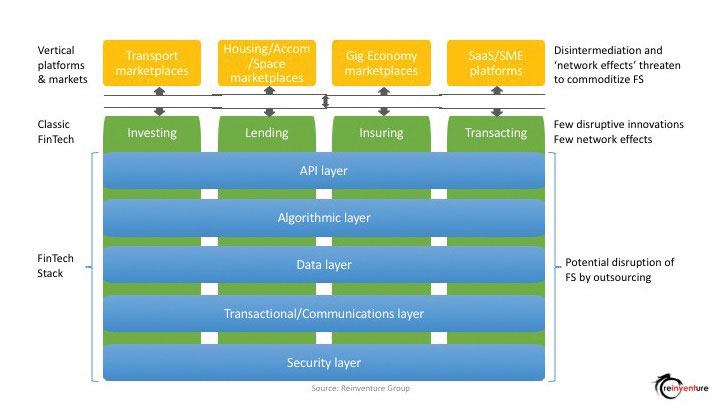
Rather than FinTech being a threat, such ventures more likely represent a form of outsourced innovation that incumbents could acquire to accelerate their transformation as they face off against the larger threat - marketplaces and platforms, often global in scope, that are disintermediating them from their end customers.
We’ve summarized the situation as we see it in the chart below:
Classic FinTech - Sustaining or Disruptive?
In the classic Clayton Christensen version of disruption, articulated in ‘The Innovators Dilemma’, disruptive ventures serve low-end or non-customers with a ‘reduced product’ at a price that is materially lower than the incumbents’. Having established a viable business model at this lower end of the market, often based on a new technology, they proceed to enhance their offering to attract more premium customers and in effect undermine the incumbent as they move up market. Rather than directly taking these challengers on, incumbents instead also look to the premium end of the market to grow profitability, making them vulnerable to the challengers overtime.
By and large, it’s become clear that classic FinTechs, rather than materially lowering price are more focussed on offering an improved customer experience. In fact, many can’t sustain a materially lower price than incumbents. For example, digital lenders make applications quicker and easier, and provide money faster and are able to secure loans against a wider array of assets. Digital insurers similarly improve the experience and convenience of purchasing insurance.
Often, FinTech ventures are able to get a jump on incumbents because they are more consumer-centric and agile in building out these products. However, this advantage is likely to be passing, as incumbents use their significant resources to buy the best people and get the product right in time. These Fintechs rarely have a sufficient intrinsic cost advantage that they can out-compete the incumbents in the long-term, particularly with incumbents’ massive distribution advantage arising from their existing customer bases. Moreover, few of these FinTech categories have demonstrated any major network effects, so it’s difficult to create a moat around these businesses and they don’t benefit from any cost of acquisition advantage, beyond simple brand awareness, as their scale increases.
Often, Fintech Ventures Are Able To Get A Jump On Incumbents Because They Are More Consumer-Centric And Agile In Building Out These Products
For such FinTechs, we recommend staying close enough to the incumbents to know when they are making build/ buy decisions and ensure they are well-positioned for acquisition.
The real threats of Financial Services disruption - Commoditization by vertical marketplaces and platforms
What is likely to be more impactful to financial services incumbents is disintermediation by vertical marketplaces and platforms that have the market power to dictate prices to financial services incumbents.
Marketplaces like Amazon, Uber, and Airbnb, and platforms like Apple, Google, Facebook, and in the small business space, Xero and Salesforce, have powerful network effects. This will increasingly give them the ability to set the price for financial services on behalf of their millions of customers, effectively turning banks into utilities. The threat posed by such marketplaces is even more stark in China, where players such as Alibaba and Tencent have gone beyond disintermediation, taking over the entire financial services stack using their own significant balance sheets. These players are now expanding globally, creating a significant disruptive threat in developed economies.
The Wildcard - Outsourcing the Stack
At each layer in the financial services stack, players are emerging to enable the outsourcing of aspects of the incumbents’ value chain, and increasingly, incumbents are taking those players up on that offer. Some layers have significant network effects which could enable monopolies at that layer over time. For example various players are combining increasingly vast amounts of open data with proprietary bank data to outsource the credit, fraud, and even compliance functions of banks and other companies, building massive network effects in the process. There is also a potentially larger long term threat here from public open blockchains. The emerging vision of a next generation internet where finance is woven into the very fabric of it has the potential to be disruptive to multiple industries including finance. Whether regulation will somehow be used to ensure that the bank monopolies are protected here is yet to be seen. These wildcards of FinTech disruption, while seemingly benign to incumbents at present, but may morph into threats over time as the financial services stack is transformed from the ground up.
Know your place in the stack
It’s often easier to see the dynamics of disruption, network effects, and other economic effects in hindsight, and our thinking on this in relation to new businesses is always evolving. Nonetheless, it’s critical for ventures to have a view on their place in the stack, as this sets your growth trajectory and exit options. Disruptive opportunities can be a slow burn, and often require substantial capital over time to get there. Big network effect opportunities similarly require the capital to ensure you are number one in a winner-takes-all market. Sustaining innovations, on the other hand, are more likely to be sprints, so knowing when to exit and positioning for acquisition is critical.
For incumbents, our advice is to consider classic FinTechs as more friend than foe while more traditional outsourcing should be done with a more conscious awareness of the market power they are handing over to suppliers. However, the major threat that incumbents should be focused on is that posed by marketplaces and platforms, particularly global platforms that are extending their incredible market power into financial services.
